
Fence Post Calculator
Plan a fence in minutes. Enter the length of each side, the post spacing and fence height, add any gates, and this calculator works out how many posts you need (split into end, corner, gate and line posts), how long they should be, how deep to dig, how many bags of concrete to buy, and how many rails and pickets the fence takes — with a simple layout drawing to check it against.
- Free to use
- No sign-up
- Runs in your browser
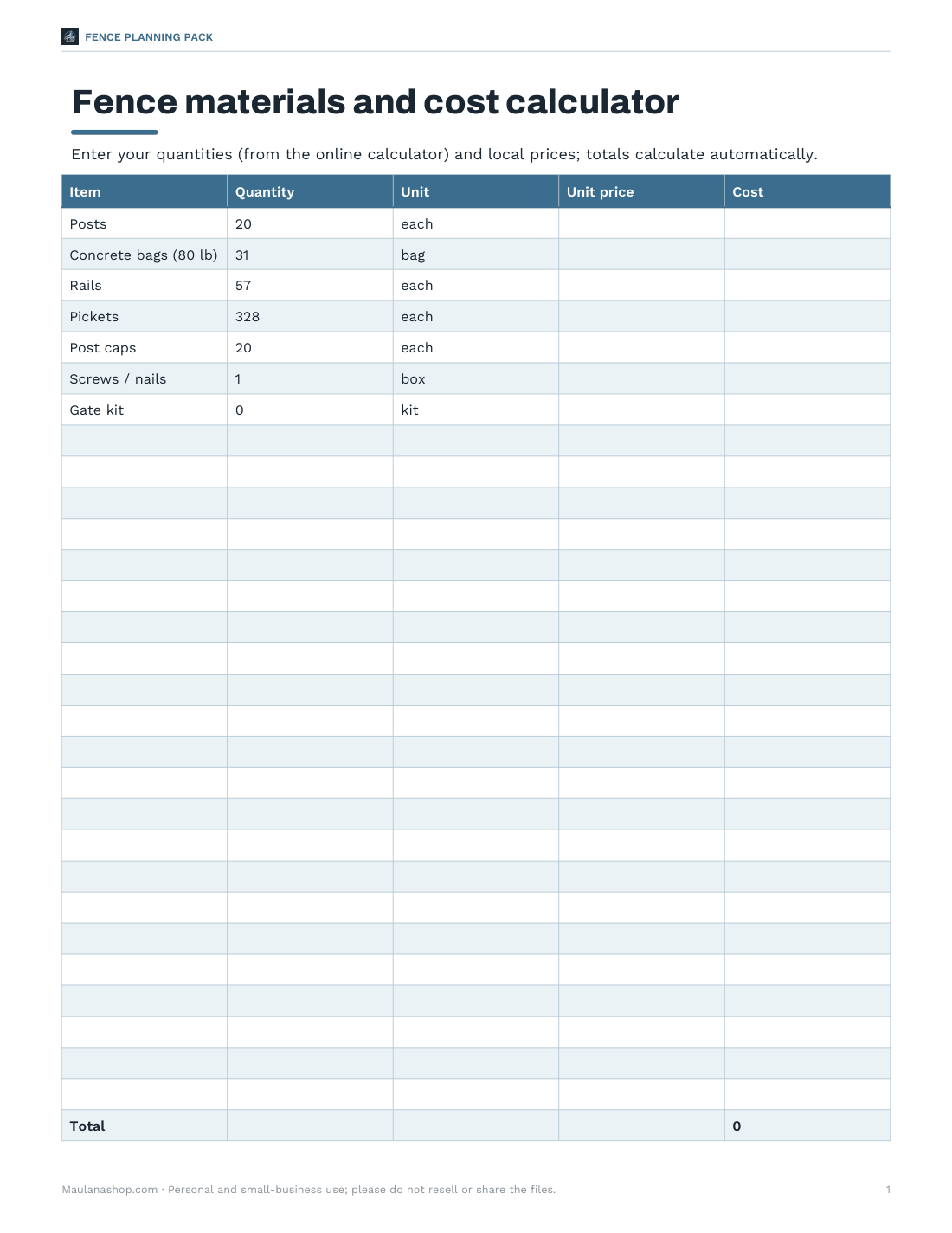
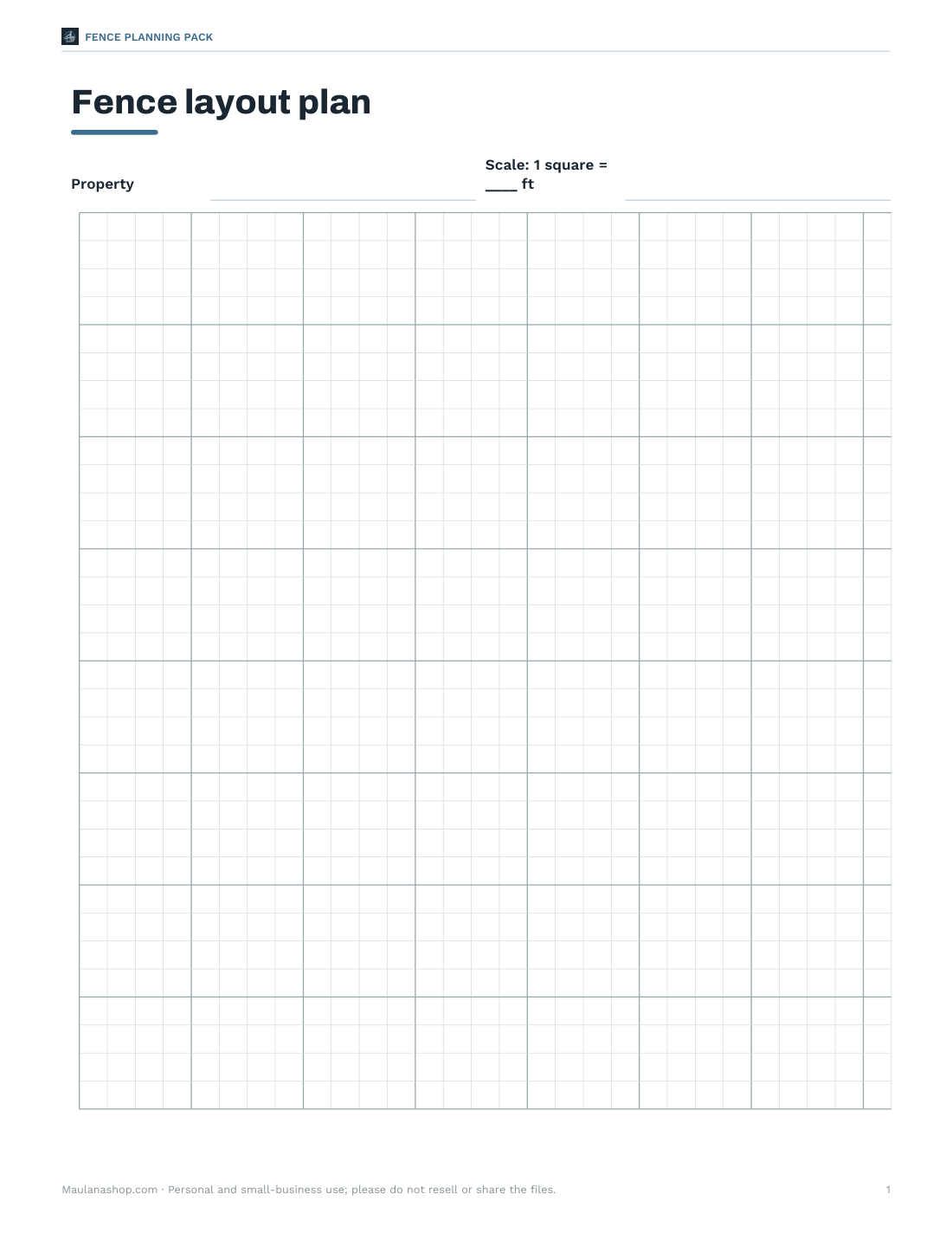
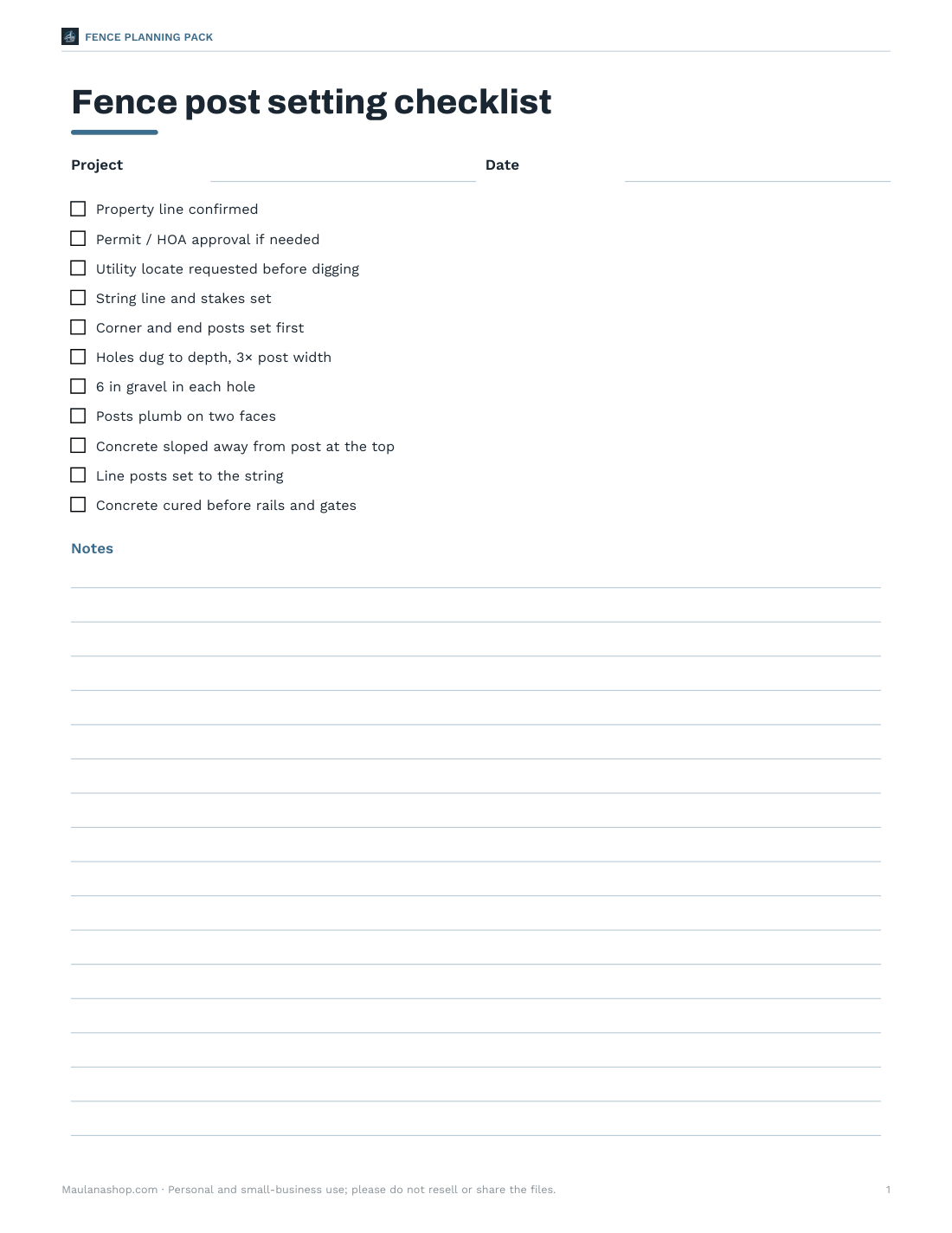
Fence post and materials calculator
Fence Planning Pack
Excel fence materials and cost calculator, fence layout graph paper, a post-setting checklist and a fence project cost and timeline worksheet.
- Calculator (XLSX)
- Layout graph paper (PDF)
- Checklist (PDF/DOCX)
- Timeline (PDF/DOCX/XLSX)
Formats: XLSX, PDF, DOCX. Instant download after payment (link valid 72 hours, up to 5 downloads). AI-assisted: the templates were drafted with AI help and reviewed and laid out before publishing.
$5.00 USD, one-time 4 files · about $1.25 each
- Instant download
- 7-day refund
- Secure checkout by Stripe
7-day money-back guarantee. Full refund within 7 days of purchase, even after you download.
Free sample: Fence Materials Calculator (PDF, 62 KB)
Full refund within 7 days — see the refund policy and license.
Free printables
Single sheets you can print right now, no sign-up. The full pack adds every sheet in one download plus the editable files.
 Fence Post Calculator Worksheet
 Printable Fence Layout Graph Paper
 Printable Fence Post Setting Checklist
 Printable Fence Project Timeline
How the calculator counts posts
Each side of the fence is divided into sections no longer than your chosen spacing. A side of 150 feet at 8-foot spacing needs 150 ÷ 8 = 18.75, rounded up to 19 sections, and 19 sections need 20 posts. Where two sides meet, they share a corner post, and a closed loop shares one more post where it returns to the start. Gates split a side into separate runs, each with its own heavy post either side of the opening. The calculator places all gates on the longest side and spaces the remaining fence evenly.
Types of fence posts
| Post | Where | What it does |
|---|---|---|
| End posts | Where the fence stops | Takes the pull of the whole run; set deeper or bigger |
| Corner posts | Changes of direction | Resists pull from two directions; often braced |
| Gate posts | Each side of a gate | Carries the swinging load; use 6×6 or heavier steel |
| Line posts | Between the others | Support rails and panels along the run |
Post spacing
Most wood privacy and picket fences use posts 6 to 8 feet apart, which matches common rail and panel lengths. Eight feet is the most common because 8-foot rails and pre-built 8-foot panels are widely available; 6-foot spacing is stronger in windy areas or for tall, solid fences. Wire and field fencing is often spaced 8 to 12 feet, and chain-link line posts are usually no more than 10 feet apart. If you are using pre-built panels, set the spacing to the panel width plus the post, and check the manufacturer’s instructions.
How deep to set fence posts
- A common rule is to bury about one-third of the above-ground height, and never less than 2 feet: a 6-foot fence needs holes about 24 inches deep.
- In cold climates, dig below the frost line so frost heave can’t push posts up — local building departments publish the depth.
- Add about 6 inches of gravel at the bottom for drainage.
- Make the hole about three times the width of the post: 10–12 inches for a 4×4.
- Call your local utility locating service before you dig.
How much concrete per post
| Post | Hole | Concrete per hole | 80 lb bags per hole |
|---|---|---|---|
| 4×4, 24 in deep | 10 in | about 0.92 cu ft | about 1.5 |
| 4×4, 30 in deep | 12 in | about 1.75 cu ft | about 2.9 |
| 6×6, 36 in deep | 18 in | about 4.67 cu ft | about 7.8 |
Volumes subtract the part of the hole taken up by the post. An 80-pound bag of pre-mixed concrete yields about 0.60 cubic feet, a 60-pound bag about 0.45 and a 50-pound bag about 0.375 — check the yield printed on the bag you buy.
Worked example
A straight 150-foot fence, 6 feet high, with 4×4 posts at 8-foot spacing and no gates needs 19 sections and 20 posts: 2 end posts and 18 line posts. Auto depth is 24 inches, so posts need to be 8 feet long, set in 10-inch holes. Each hole takes about 0.92 cubic feet of concrete, 18.4 cubic feet in total, which is 31 bags of 80-pound mix (or 50 bags of 50-pound). With three rails per section you need 57 rails, and 5½-inch pickets butted together need 1,800 ÷ 5.5 = 327.3, rounded up to 328 pickets.
Adding gates
- A walk-through gate is usually 3½ to 4 feet wide; a single-car driveway gate 10–12 feet, often as a pair.
- Gate posts should be the heaviest in the fence and set deeper — some builders go 6 inches deeper than line posts.
- Allow for hinge and latch gaps (about ½ to ¾ inch each side) when you set the posts.
- Install the gate after the concrete has fully cured.
Materials checklist
- Posts (plus one or two spares)
- Concrete or gravel for setting
- Rails and brackets or screws
- Pickets or panels plus 5–10% waste
- Post caps
- Gate kit: hinges, latch, drop rod
- Tools: post hole digger or auger, level, string line, stakes, tape measure
Before you build
Confirm your property line, check local fence height rules and any homeowners’ association rules, and talk to neighbours. Many places limit front-yard fences to around 3–4 feet and back-yard fences to around 6 feet, and some require a permit. These rules vary widely, so check with your local planning office.
Printable fence planning pack
The optional pack includes an Excel fence materials calculator with costs, a fence layout graph paper, a post-setting checklist and a project cost and timeline worksheet. The calculator above is free to use without it.
AI-assisted content
Explanations were drafted with AI assistance and reviewed before publishing. Figures are planning estimates; follow your local codes and product instructions.
Frequently asked questions
How many fence posts do I need for 100 feet?
At 8-foot spacing, 13 sections and 14 posts for a straight run.
How far apart should fence posts be?
Usually 6–8 feet for wood fences.
How deep should fence posts be?
About one-third of the fence height and at least 2 feet, below the frost line in cold areas.
How many bags of concrete per fence post?
About 1.5 bags of 80 lb mix for a 4×4 post in a 10-inch hole 24 inches deep.
What length post for a 6 ft fence?
An 8-foot post with 2 feet in the ground.
Do corner posts need to be bigger?
They take more load, so many builders use larger or braced posts at corners, ends and gates.